

“America Is Decades Behind”: Asia’s 400 MPH Floating Trains Expose Our $128 Billion Rail Disasters While Transportation Crumbles
 By
Renée Castellano
By
Renée Castellano
| IN A NUTSHELL |
|
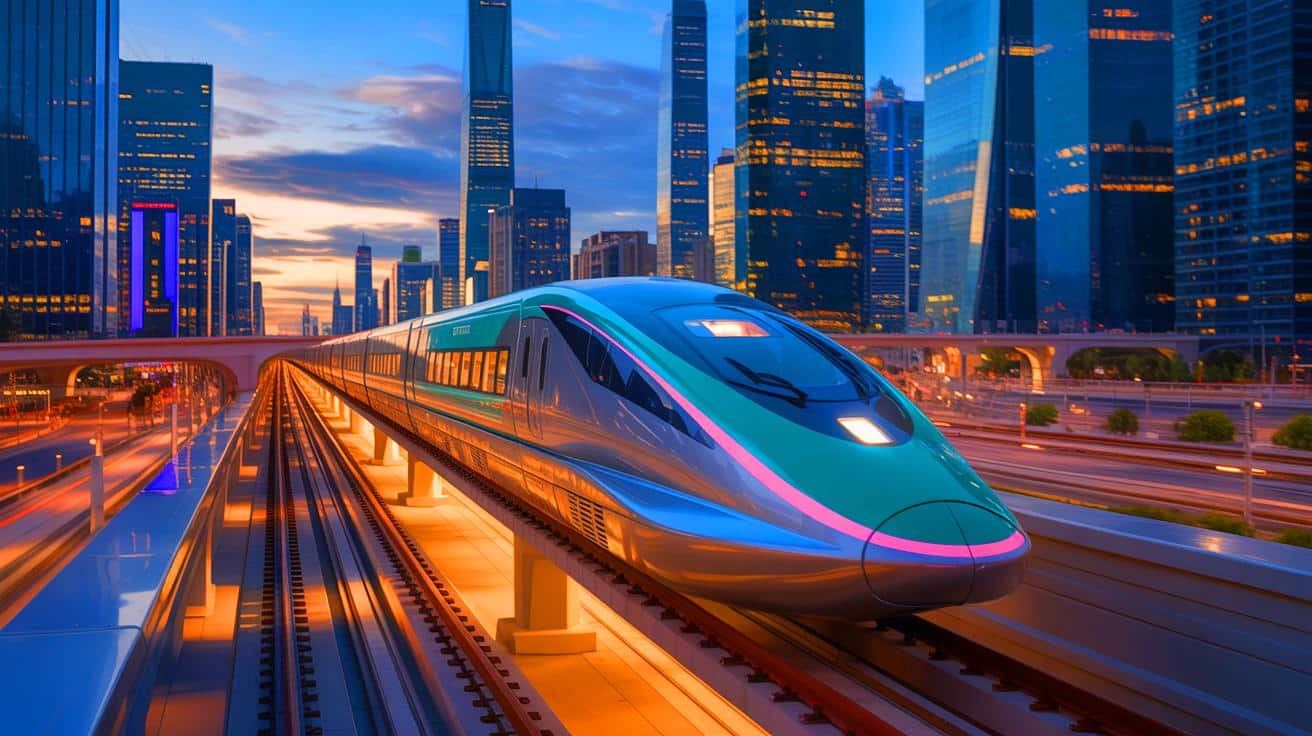
Imagine gliding across vast distances at nearly 400 miles per hour on a train that floats silently above its tracks. This is not a scene from a science fiction novel but the promise of magnetic levitation, or maglev, trains. While Japan and China are breaking speed records and bringing this technology to life, projects in the West lag behind. This disparity in adoption raises questions. Why has Asia taken the lead, and what does this mean for the future of travel? Understanding the dynamics between technological advancement and cultural priorities might shed light on this intriguing phenomenon.
From Bullet Trains to Magnetic Levitation
High-speed rail has been a cornerstone of transportation innovation in Asia for decades. Japan’s Shinkansen bullet trains revolutionized train travel in 1964, setting the stage for fast, efficient rail systems. China has since built the world’s largest high-speed rail network, with trains cruising at speeds between 186 and 217 mph. This success laid the groundwork for the adoption of maglev technology.
In 2004, China introduced the Shanghai Maglev line, the world’s first commercial maglev train. This train connects Pudong Airport to downtown Shanghai in a mere 7.5 minutes, covering 18.64 miles and reaching speeds of 268 mph. Japan has developed its superconducting maglev (SCMaglev) and set a world record in 2015 when an experimental train reached 374 mph. The SCMaglev line between Tokyo and Nagoya is under construction, promising to cut travel times dramatically. South Korea has also embraced maglev technology with a smaller urban line in Incheon, but China and Japan remain leaders in this field.
The Physics Behind Floating Trains
Maglev technology relies on the simple yet powerful principle of magnetism, using electromagnets to lift and propel trains without physical contact with the tracks. This eliminates rolling resistance, providing both speed and smoothness. There are two main maglev systems in use: Electromagnetic Suspension (EMS) and Electrodynamic Suspension (EDS).
Why trucks remain essential for small businesses in the modern era
EMS: Used in Shanghai’s Transrapid system, EMS employs electromagnets under the train’s carriage to lift it toward a steel track. Advanced sensors continuously adjust the magnet strength to maintain stability. This system allows the train to levitate at a standstill.
EDS: Japan’s SCMaglev uses superconducting magnets cooled to cryogenic temperatures. At lower speeds, wheels support the train, but as it accelerates past 93 mph, repulsive forces lift it about 4 inches above the guideway. The track functions as a giant linear motor, propelling the train forward.
Both systems ensure stability through sophisticated magnet design and onboard controls, allowing maglev trains to maintain alignment even at speeds over 300 mph. A famous demonstration showed a coin balanced on the floor of a Japanese maglev during high-speed travel, remaining upright throughout.
The Passenger Experience
For passengers, the maglev experience is radically different from traditional rail travel. The absence of wheels eliminates the clatter and vibrations commonly associated with trains, offering a smooth and quiet ride. Acceleration is seamless, and curves are stable, with air resistance as the only significant friction.
Maintenance requirements are reduced in some respects, as maglev trains have fewer mechanical components like wheels and axles that require replacement. However, the infrastructure costs are significantly higher, as maglev requires entirely new guideways. This financial hurdle makes maglev adoption challenging despite its benefits.
Asia vs. the West: Why the Gap?
In the United States, high-speed rail projects like California’s initiative to connect Los Angeles and San Francisco have faced substantial delays and cost overruns, with budgets ballooning from $33 billion to over $128 billion. Similarly, a proposed maglev line between Washington, D.C., and Baltimore is stalled due to halted environmental reviews.
How supercars are changing the face of automotive technology
In Europe, the story is similar. Britain’s High Speed 2 (HS2) project saw costs rise from £33 billion to over £100 billion, leading to the cancellation of its northern section. Germany, despite inventing maglev, canceled its Munich airport project in 2008. Several factors contribute to Asia’s lead in maglev adoption.
China and Japan have prioritized high-speed rail as national objectives, investing heavily in construction and research. High population density and demand for intercity travel make such projects economically viable. Additionally, cultural priorities in Asia position high-speed rail as a strategic industry, whereas the U.S. and Europe often rely on air travel and existing rail upgrades.
The Limits of Maglev
Despite its promise, maglev technology faces significant challenges. The Shanghai Maglev line, while record-setting, has not been extended due to high costs and public concerns over noise and electromagnetic effects. Most of China’s network relies on conventional high-speed trains, which are more cost-effective.
Japan’s SCMaglev has experienced delays due to environmental concerns, particularly regarding groundwater impacts. Even with Japan’s commitment, the Tokyo, Nagoya segment won’t be operational until at least 2034. The need for entirely new infrastructure is a significant financial barrier for many countries.
Maglev trains represent the cutting edge of ground transportation, faster, smoother, and quieter than anything before. They demonstrate how engineering ambition, when matched with political will and public investment, can transform mobility. However, the challenges faced by these projects also highlight the importance of strategic planning and investment. As Asia continues to push the boundaries of what’s possible, will the West find the resolve to catch up in the race for high-speed rail innovation?
Continue reading