

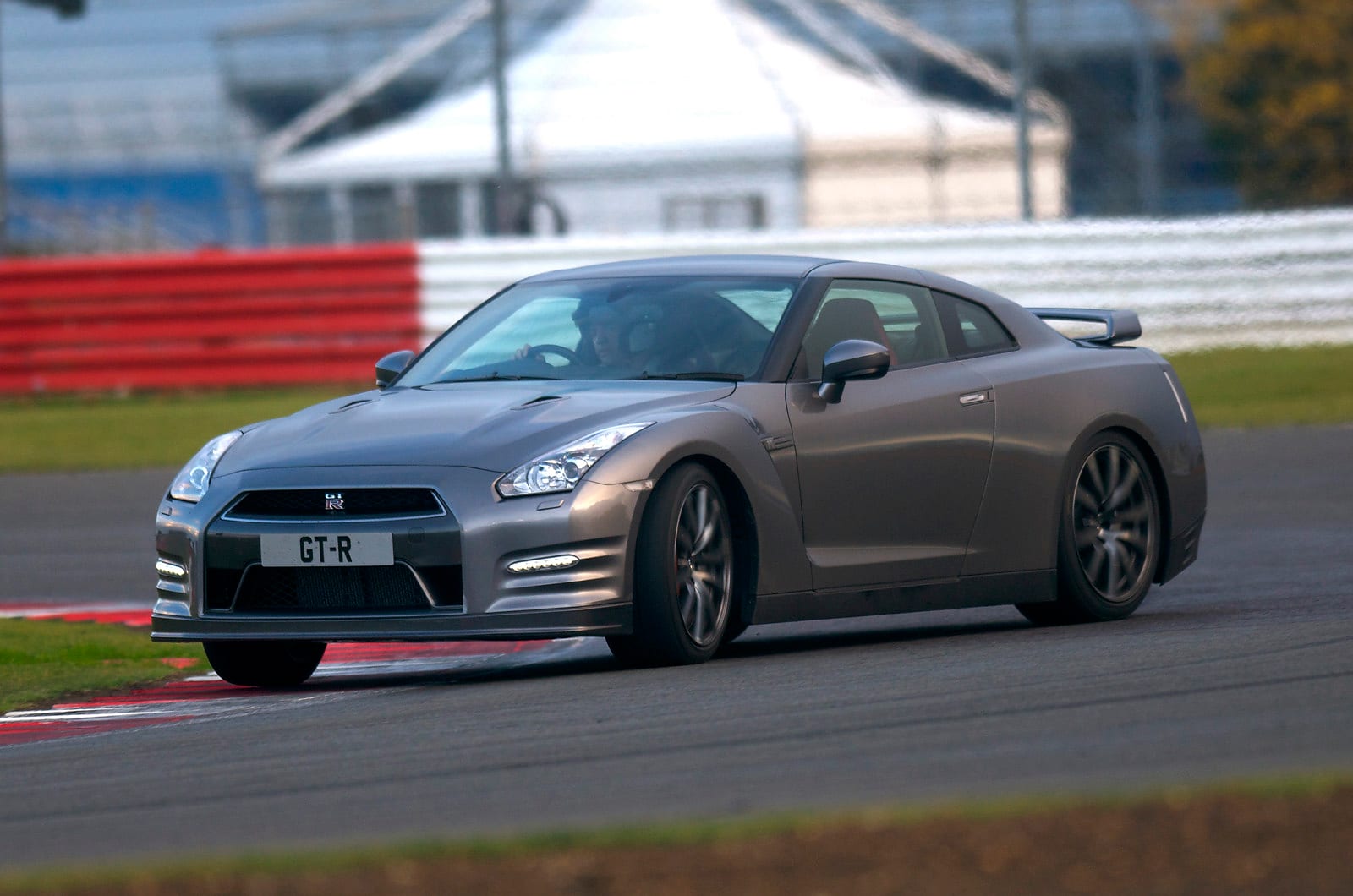
Godzilla, that eponymous hero/villain of the Japanese movie series, was derived by storytellers as the horrific combination of a gorilla and a whale. (To think of a whale and gorilla doing the nasty conjures up all sorts of bad images, but we digress) That combo would serve as a good basis for the DNA of Nissan’s legendary GT-R supercar. Known in enthusiast circles as “Godzilla,” it is a brute example of a car that is part docile creature, part street fighter, and larger-than-life all at the same time.
After maintaining its status as unobtanium in the automotive world, but nonetheless the holy grail of every kid who has ever picked up a PlayStation controller, Nissan’s long-awaited, fifth generation GT-R finally officially hit North American shores in mid-summer. Leftlane has recently had some quality time in the latest legend to bear the GT-R moniker, and we came away with a pretty good feel for one of the most impressive pieces of chest-hair enhancing devices that we have ever driven.
What is it?
A derivative of the Nissan JDM (Japanese Domestic Market) Skyline model, the GT-R has now dropped the Skyline designation as it is currently used by the firm’s sedans and coupes sold in North America as the Infiniti G35 and G37. This new GT-R is an all-wheel-drive supercar that is a step above the model it replaces, which incidentally has not been built since 2002. Based on Nissan’s new premium midship platform, it has achieved its mythical status by exposure on the Grand Turismo series of video games and through appearances in the “Fast and Furious” film franchise.
What’s it up against?
Performance-wise, the GT-R competes with the Aston Martin DB9, the Audi R8, the Lamborghini Gallardo, the Maserati GranTursimo, and the Porsche 911 Turbo in the super- and near-supercar niches. Price wise, the Maserati ranks closest to the GT-R, although by the time dealers add “market adjustment rates,” or gouge the sticker, (take your pick of euphemisms) the GT-R might end up in the price range of its competition anyway. With an estimated 1,500 models being imported to the US, it won’t be easy finding a GT-R that hasn’t already been spoken for.
Any breakthroughs?
On sale in the U.S. for the first time since mid-summer, the Nissan GT-R breaks through with it calls the world’s first independent rear transaxle. Known internally as the Attesa E-TS all-wheel-drive system, it places the tranny, transfer case and final drive at the rear of the car, with only a carbon composite driveshaft running down the length of the transmission tunnel.
Add to that a hand-built VR series 3.8-liter twin-turbo V6 for power that seems more at home from a V8 rather than a six.
How does it look?
Looking like a bird of prey, the new GT-R features the looks of a Pterodactyl without the wingspan. The GT-R is a combination of aluminum hood, door panels, and trunk lid, combined with carbon fiber cross members and radiator supports. Crisply formed body panels are forward looking while at the same time incorporating a downforce that is felt at speed. The rear of the GT-R pays homage to Skylines of the past with the use of the pair of rings housing LEDs on each side.
Underneath, carbon trays clean up the aero and help to realize the principle of the inverted wing for more ground force. The front fenders are vented to assist airflow around the tires, releasing trapped air that would help to cause lift, a no-no during high-velocity runs to the local Rave and Rant. Definitely futuristic, it is a look we were not entirely on board with when viewing images on the web, but when viewed in the flesh, it is definitely an appealing sight. As with fine wines, and sushi, it’s definitely an acquired taste.
And inside?
A functional driver and passenger area awaits, although we question the need for a rear seat that really does no one any favors. Rather than have a rear seat, why not jettison it all for a weight savings of 150 to 200 pounds. Regardless, all seats in the GT-R are in a nicely covered leather and suede material to keep things in place during high g-load curves which we negotiated as we became more familiar with the GT-R’s handling and chassis dynamics. Quality is in evidence everywhere from the French-stitched leather trimmed dashboard to other points including the brushed aluminum accents throughout the cockpit.
The steering wheel assembly is mounted in a swivel-like binnacle that pivots up or down depending on the height of the driver. The wheel itself, mounted on a telescoping column is covered in smooth and perforated leather and features a pair of paddle shifters for up and down gear changes of the rear-mounted fly by wire transmission. The gauge binnacle is centered by a large tachometer, and flanked by a speedo on the left, and fuel as well as temperature gauges on the right. User configurable, various info readouts can be seen on the LCD panel within the tach field, to show digital speed readouts, mileage, miles until empty and so on.
The center stack is crowned by a seven inch monitor with a design inspired by the GranTurismo video games that first introduced this line of Nissan supercars to gamers everywhere. Infinitely adjustable, it can display 11 pages of data including turbo boost, acceleration, g-forces, fuel consumption, launch profiles, as well as a scratch pad for driver input. Moving further down, you’ll find the standard climate controls and then the good stuff: At the base of the stack is a panel housing switches to customize the drive system, the shock rates (from comfort to sport) and the ability to turn the traction control system on and off.
But does it go?
Can I get a “Hell, yeah?”
The heart of the GT-R is the 3.6-liter twin turbo 24-valve V6 engine. With each engine hand built by a single technician at Nissan’s Yokohama engine factory, it is a departure from the inline six-cylinder engines that powered previous versions of the GT-R Skyline. After much hand wringing by enthusiasts, we can honestly say their mutterings were for naught. Cranking out 480-horsepower at 6,400 rpm, and producing torque in the neighborhood of 430 lb-ft. (a very nice neighborhood, at that), the new engine is designated VR38DETT, and features plasma-sprayed bores to reduce friction, enhanced cooling and twin IHI turbochargers. It is a piece of art under the aluminum hood that needs to be seen and appreciated.
The GT-R is built on a jig similar to the way prototype racers are constructed. This process supposedly eliminates inconsistencies from car to car. With the limited number of cars available, it would probably be difficult to get many in one place at one time to compare notes, much less measurements.
Cranking the new six yields a satisfying gurgle from the pair of twin tailpipes. Tip-in requires a bit of effort as the GR-6 sequential six-speed will hold a gear at idle with its Hill Start Assist. Driving through the neighborhood attracted the attention of nearly every teenaged kid around. Pulling onto Okeechobee Boulevard in West Palm Beach found us steering clear of Fan Boys in their souped up Honda Civics as they struggled to make photos of the GT-R with their cell phone cameras. Soon we would be westbound on Southern Boulevard.
The dual clutch feature handles odd (1,3,5) and even (2,4,6) gear changes to preselect the next highest or lowest gear, and does so, according to Nissan, with race car quickness. We’d agree, as we found out on Highway 441 in rural central Florida. Passing was effortless and caused facial distortions like those old films of NASA astronaut candidates undergoing tests in the centrifuge. Hit the six-pot front/four-pot rear Brembo brakes to feel your face distort in a totally different direction as the 15-inch rotors are clamped to a stop.
The GT-R’s handling is stellar which is saying a lot. Designed so you won’t get in over your head, it has just enough in the way of electronic doodads to help save you from yourself. Or you can just switch them off. Hotfooting through a sweeping right-hander near Lake Okeechobee found the GT-R exhibiting some understeer, which was both expected and welcome. The front suspension’s double wishbones with aluminum upper arms and the rear multi-link with Bilstein DampTronic adjustable shocks at all four corners allowed for adaptability through many of our driving surfaces. Setting the switch to comfort mode did not exactly make the washboarded highways smooth out like glass, but it didn’t beat us up nearly as bad as it could have. Our test vehicle was equipped with 20-inch Dunlop SP run flats, which gave off a good bit of noise that could probably be attributed to the graininess of the Florida asphalt. Steering is controlled by an electronically controlled rack and pinion system with speed sensitive power assist.
Overall, we’d have to say we haven’t enjoyed a test ride lately, as much as we did in our – er, Nissan’s – GT-R.
Why you would buy it?
You would like a chance to own a supercar that should sell for nearly twice the price, and has performance that is better than most other exotic cars available today.
Why you wouldn’t?
You don’t own a video game set up, and besides, who wants to be fast and furious anyway? This isn’t a car for purists.
2009 Nissan GT-R base price, $76,840. As tested, $80,840.
Super Silver paint, $3,000; Destination, $80,840.