

“Rider Calls It Pure Madness”: Indian Challenger Bagger Smashes Bonneville Record At 196 MPH And Redefines What Touring Bikes Can Do
 By
Keisha Holloway
By
Keisha Holloway
| IN A NUTSHELL |
|
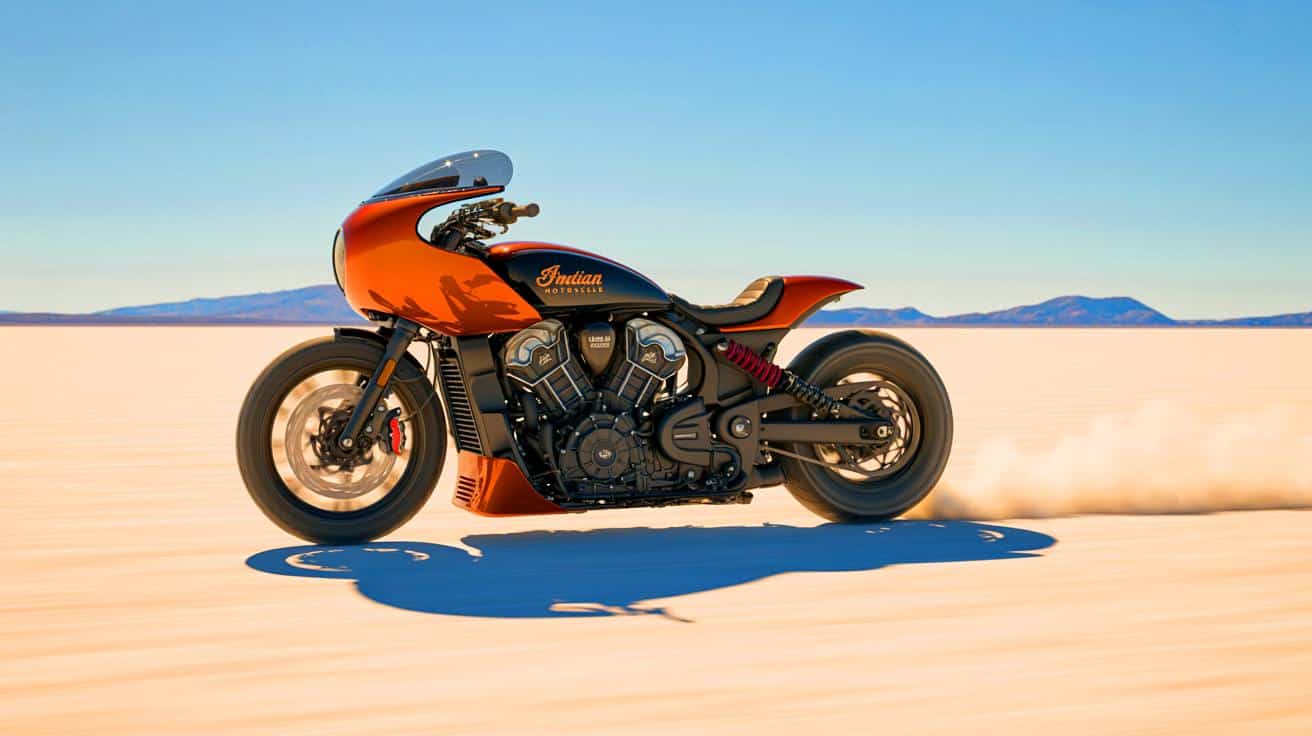
Indian Motorcycle has once again proven its prowess on the racing circuit by setting a new land speed record with its race-spec Challenger. Achieving nearly 200 miles per hour at the Bonneville Salt Flats, the feat is a testament to the company’s rich history of racing excellence. With the legendary Tyler O’Hara at the helm, the Indian team collaborated with S&S Cycle and Mission Foods to push the boundaries of what a bagger motorcycle can accomplish. This record-breaking run not only highlights the technical advancements of Indian Motorcycles but also solidifies its place as a leader in high-performance engineering.
The Evolution of Indian’s Racing Legacy
Indian Motorcycle has a storied past filled with triumphs on the racing front. From the early days of Ed “Iron Man” Kretz’s victory at the 1937 Daytona 200 to the dominance of the original Wrecking Crew, Indian has consistently supported champions. Jared Mees continues this legacy with his current dominance on the flat track, showing that Indian’s dedication to racing is unwavering.
This new land speed record at Bonneville adds another remarkable achievement to Indian’s portfolio. The team, led by Tyler O’Hara, aimed to see just how fast the King of the Baggers race bike could go. This attempt not only shattered previous records but also paid homage to the legendary Burt Munro, who famously achieved 191 mph on a 1920 Scout in 1967.
The record-breaking run was a collaborative effort with S&S Cycle, highlighting the power of partnership in achieving extraordinary feats. By reaching speeds of 196.576 mph, Indian has firmly established its place in the annals of motorcycle racing history.
Pushing the Limits: Technical Innovations
The Indian Challenger used for this record attempt was no ordinary bike. Built on a stock Challenger race bike, it featured significant modifications to enhance performance. The heart of the machine is Indian's 112 cubic inch PowerPlus V-twin motor, which in its stock form produces 126 horsepower.
S&S Cycle made several key modifications, including larger throttle bodies, ported cylinder heads, and race camshafts. The compression ratio was increased to take advantage of high-octane fuel available at Bonneville. The result was a machine capable of producing around 150 horsepower and 150 lb.ft of torque.
Further enhancements included customized forged wheels, top-spec Brembo brakes, and sophisticated suspension components from Öhlins. These upgrades ensured that the Challenger could handle the extreme speeds encountered during the record attempt.
Design Adaptations for Speed
The design of the Challenger was also meticulously adapted to maximize its potential. The entire bodywork, including the saddlebags, was crafted from carbon fiber to reduce weight. The tank was modified to provide a more aerodynamic riding position, while the front fender and fairing were reshaped for better airflow.
Rider Tyler O’Hara described the experience of reaching such high speeds on a bagger as both thrilling and challenging. "You're leaning into it, and you get the green flag...it's sketchy, you're going 190 miles an hour, and then wooo, you're across the finish line," he explained. This raw description captures the sheer intensity and exhilaration of pushing a motorcycle to its limits.
The design changes, combined with the powerful engine modifications, allowed the Challenger to reach unprecedented speeds, setting a new standard for performance in the bagger category.
Volkswagen Unleashes Its Own Epic Gymkhana Video: A Thrilling Ride!
Implications for the Motorcycle Industry
The success of Indian's Challenger at Bonneville has wider implications for the motorcycle industry. It challenges the perception of baggers as purely touring machines, showing that they can achieve incredible speeds while maintaining their iconic design.
This achievement may inspire other manufacturers to explore the potential of their touring models, leading to a new era of performance-oriented baggers. The advancements made by Indian and its partners could pave the way for further innovations in motorcycle engineering.
As the motorcycle industry continues to evolve, the record set by Indian at Bonneville serves as a reminder of the endless possibilities that lie ahead. It highlights the importance of pushing boundaries and embracing innovation in the pursuit of excellence.
The record-breaking feat by Indian Motorcycle at Bonneville has opened new avenues for exploration in the world of high-speed racing. By redefining what a bagger can achieve, Indian has set a new benchmark for performance and innovation. As the motorcycle industry continues to evolve, one must wonder: what other records will be shattered in the pursuit of speed and excellence?