
“This Should Not Exist”: Tyler O’Hara Hurls 600-Pound Indian Challenger To 194 Mph, Destroying A Record Untouched Since 1972
 By
Ethan Kowalczyk
By
Ethan Kowalczyk
| IN A NUTSHELL |
|
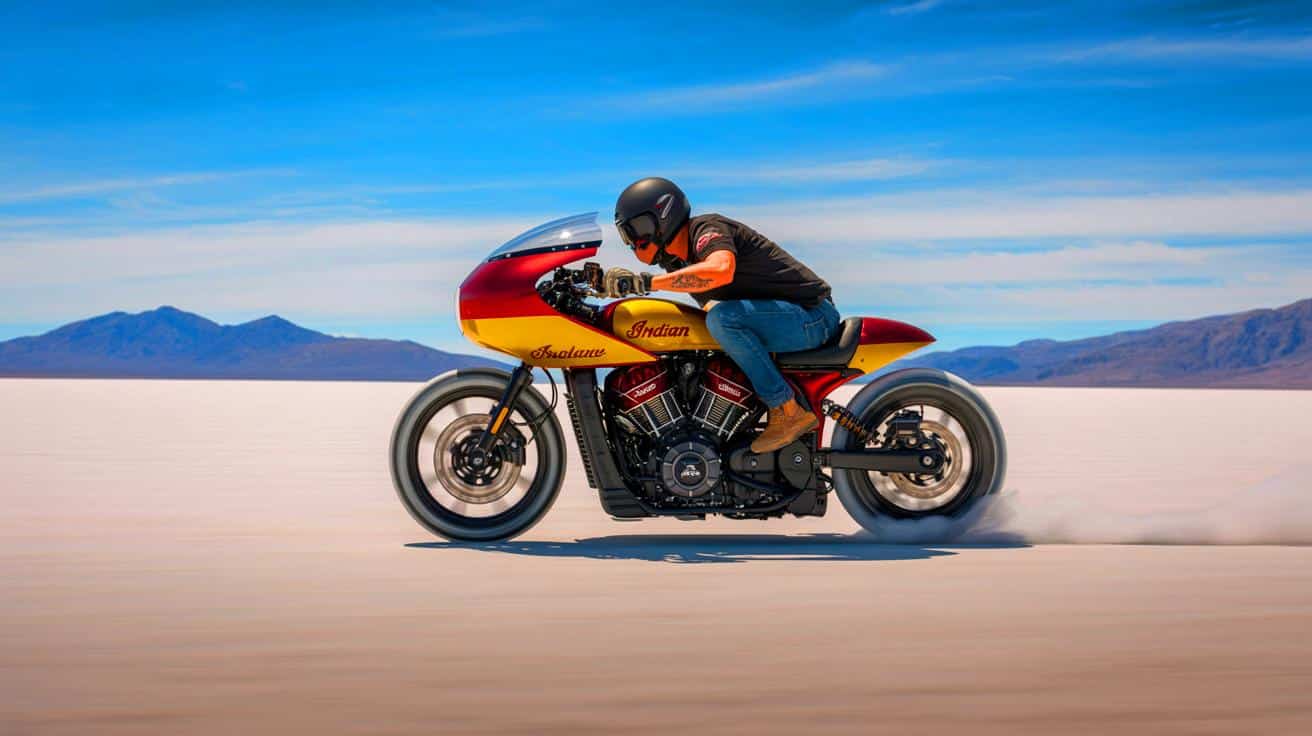
In a remarkable display of speed and engineering prowess, Indian Motorcycle recently pushed the boundaries of what a touring bike can achieve. Taking to the Bonneville Salt Flats, the company’s race-spec Challenger, piloted by Tyler O’Hara, achieved nearly 200 miles per hour, rivaling the speeds typically associated with top superbikes. This demonstration not only highlighted the capabilities of American-made baggers but also underscored Indian Motorcycle’s long-standing legacy in competitive racing. Partnering with S&S Cycle and Mission Foods, Indian Motorcycle has once again proven that baggers are not just about style but also serious contenders in the speed arena.
Racing Legacy Meets Modern Speed
Indian Motorcycle’s storied history in racing is rich with achievements and iconic moments. From Ed “Iron Man” Kretz’s victory in the 1937 Daytona 200 to Jared Mees’ dominance in today’s flat track racing circuits, the brand has consistently pushed boundaries and backed champions. The recent land speed record at Bonneville adds yet another milestone to this illustrious legacy. The company’s latest endeavor pays tribute to historical figures like Burt Munro, who famously hit 191 mph on a 1920 Indian Scout in 1967. O’Hara’s exhilarating run not only surpassed Munro’s legendary feat with a first-run speed of 192 mph but also honored the spirit of those early races.
O'Hara's skill and daring were evident as he leaned into corners, showcasing an impressive technique on a large motorcycle that lacked full streamlining. This was a nod to Munro’s 1960s attempts, which were groundbreaking at the time. Observers, like Joe Salas, noted the remarkable level of control and precision O’Hara exhibited, further testament to the advancements in motorcycle engineering and the rider’s expertise.
Setting a New Record
The efforts at Bonneville resulted in an outstanding achievement. After fine-tuning the Challenger, O'Hara made a second run, clocking in at an impressive 196.576 mph. This culminated in a two-run average of 194.384 mph, breaking the previous American Motorcycle Association record for the 2000cc APS-AG category. This record had stood since 1972 when J. Angerer set it at 169.828 mph on a Triumph. This achievement marks a significant leap in performance and engineering.
Volkswagen Unleashes Its Own Epic Gymkhana Video: A Thrilling Ride!
The Bonneville Challenger started as a stock race bike but underwent significant modifications by S&S Cycle. The 112 cubic inch PowerPlus V-twin engine, which produces 126 horsepower in its standard form, was enhanced for speed. Modifications included larger throttle bodies, ported cylinder heads, a specialized exhaust system, race camshafts, and a higher compression ratio. Additional upgrades involved replacing the crankshaft and tuning the exhaust for optimal flow. While official horsepower figures remain undisclosed, estimates suggest that the bike produces around 150 horsepower and 150 lb.ft of torque.
Experiencing 200 MPH on a Bagger
Riding a 600-pound bagger at nearly 200 mph offers a unique experience, as described by O’Hara. "You grab sixth gear, get the green flag, and you’re doing your best to go as fast as you can. The bike’s moving left-to-right, your mind’s telling you to ease off, but your gut’s telling you to stick with it. It’s uncomfortable, sketchy, and then wooo, you’re across the finish line," he recounted. This vivid description underscores the challenge and thrill of piloting such a powerful machine at high speeds.
This achievement demonstrates that American touring bikes can indeed compete with superbikes in terms of speed. While most 200-horsepower sport bikes tend to top out around 190 mph, Indian’s Challenger, a bagger, managed to rival them on the salt flats. This accomplishment has not only expanded the possibilities for touring bikes but also challenged preconceived notions about their capabilities.
The recent success at Bonneville represents a significant milestone in the evolution of American motorcycles. By proving that baggers can match the speeds of superbikes, Indian Motorcycle has paved the way for further innovations in the industry. As technology continues to advance and new records are set, one question remains: How far can the boundaries of motorcycle engineering be pushed in the pursuit of speed?