


“They Want Cars to Fly Their Own Drones”: Toyota’s Wild New Patent Reveals Off-Road Vehicles With Aerial Scouts (and It Might Actually Work)
 By
Avi Cohen
By
Avi Cohen
| IN A NUTSHELL |
|
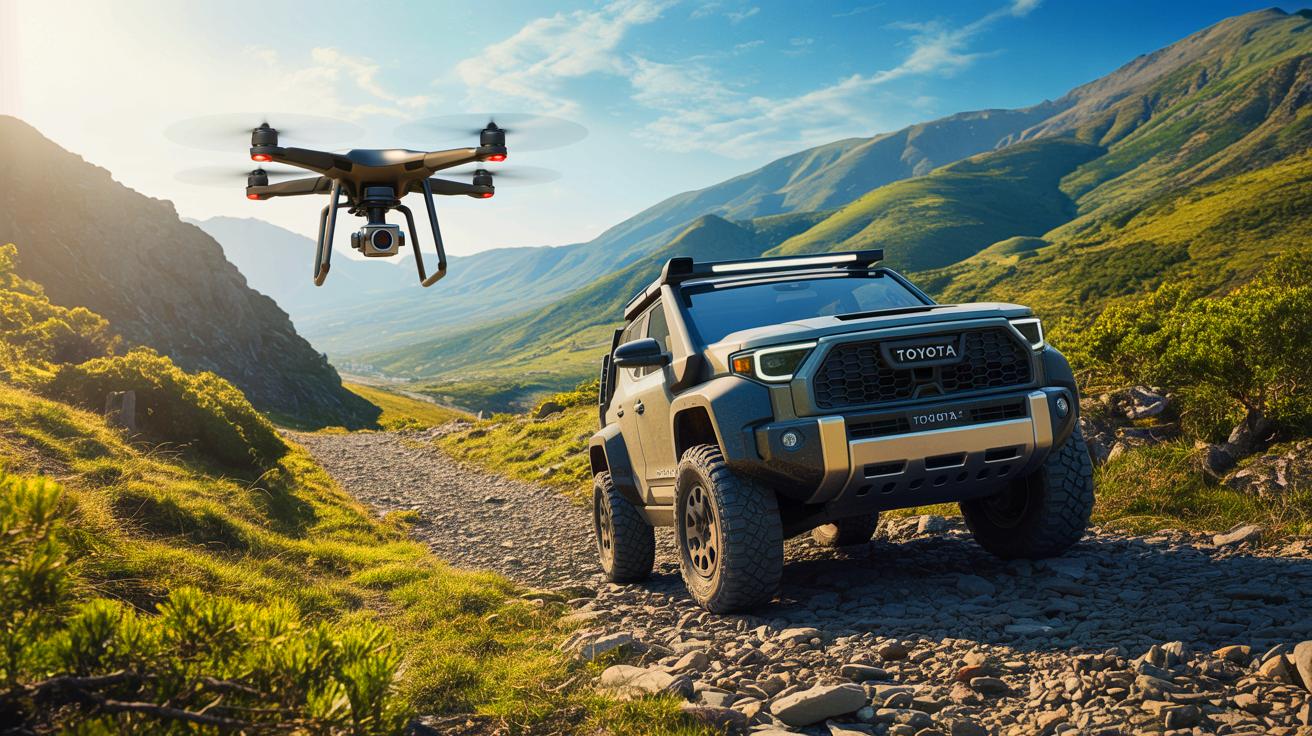
Toyota Motor has taken a significant step into aerial technology, as revealed by a recent filing with the Federal Aviation Administration (FAA). The Japanese automaker is exploring the use of drone systems to assist off-road drivers by providing real-time terrain views. This innovative idea marks a new direction for automakers, leveraging drones beyond their traditional roles in delivery and other industries. By offering an aerial perspective, Toyota aims to enhance driver safety and situational awareness, particularly in challenging environments where traditional navigation methods may fall short.
Why Automakers Are Turning to Drones
The automotive industry’s interest in drones is growing, as evidenced by Toyota’s recent proposal. This shift highlights a broader trend in which automakers are exploring unmanned aerial systems to address challenges that ground vehicles face. Unlike Toyota’s investment in Joby Aviation’s electric air taxis, the off-road drone concept is tailored to assist traditional vehicles by improving safety and awareness.
As drone technology becomes more affordable and regulatory frameworks evolve, automakers are increasingly considering aerial systems as practical solutions for real-world problems. In off-road scenarios, stepping out of a vehicle to survey the terrain can be hazardous. Drones offer a safer alternative by providing a comprehensive view of potential obstacles and hazards from the sky, reducing the need for drivers to leave their vehicles and enhancing their ability to navigate safely.
How the System Would Work
According to the FAA filing, Toyota’s drone system aims to offer drivers clear views of their surroundings, highlighting potential hazards and enabling safer route planning. The drones are designed to operate primarily near the vehicle but can occasionally fly above treelines to capture a broader view of the terrain.
This system could be particularly beneficial for overlanders, search-and-rescue teams, and military operations where terrain knowledge is crucial. Essentially, it transforms off-road vehicles into reconnaissance units, equipped with their own aerial scouts to assess and navigate challenging environments effectively.
Toyota Set to Electrify with New Land Cruiser and RAV4 Electric Vehicles
Regulatory Support and Reality Check
Toyota’s filing aligns with recent updates in U.S. drone regulations. In August 2025, Transportation Secretary Sean Duffy introduced new rules for Beyond Visual Line of Sight (BVLOS) operations, aiming to expand commercial drone applications across various industries, including automotive systems.
The proposed rules would allow drones to operate without case-by-case waivers, potentially enabling applications in delivery, agriculture, infrastructure, and automotive systems.
https://leftlanenews.com/toyota-four-cylinder-engine/727/
Toyota’s filing references these proposed rules, indicating the company’s readiness to pursue development if the regulatory environment becomes supportive. However, a company spokesperson emphasized that this is an exploratory concept, with no immediate product plans. The filing reflects Toyota’s interest in testing regulatory waters and exploring possibilities, rather than committing to a specific product launch.
Potential Applications and Future Implications
The integration of drones into automotive systems could have far-reaching implications. For off-road enthusiasts, such a system would offer unprecedented safety and convenience, transforming how drivers interact with rugged terrains. Beyond recreational use, the technology holds promising applications for emergency services. Search-and-rescue teams could benefit from enhanced situational awareness, potentially saving lives in time-critical situations.
Military applications could also be significant, providing troops with real-time reconnaissance capabilities in unfamiliar or hostile environments. The concept’s adaptability across various fields underscores the versatile potential of drones in augmenting traditional vehicle operations and enhancing safety measures.
As Toyota continues to explore this innovative concept, questions remain about the practical implementation and public acceptance of drone-assisted driving. How will these technologies be integrated into existing vehicle systems, and what impact will they have on the future of off-road navigation and safety?
Continue reading