

“This Tube Just Changed Travel Forever”: Dutch Hyperloop Hits Record Speed and Perfect Lane Switch, Paving Way for 435-Mph Transit Revolution
 By
Avi Cohen
By
Avi Cohen
| IN A NUTSHELL |
|
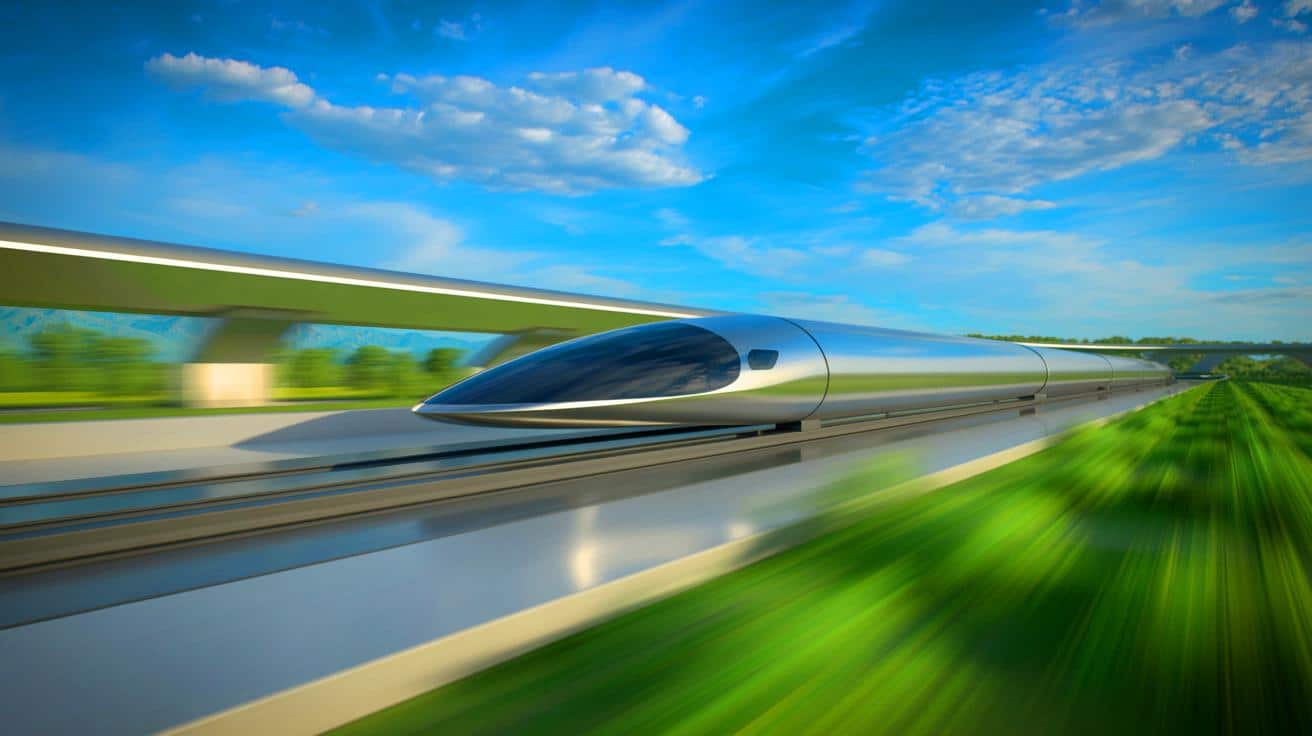
The high-speed transportation sector is on the cusp of a revolutionary change as the hyperloop, once a theoretical concept, inches closer to practical implementation. Leading this innovation is Hardt Hyperloop, a Dutch company that recently set a new European speed record. During a crucial test at the European Hyperloop Center in Veendam, Netherlands, their vehicle not only achieved a speed of nearly 53 miles per hour but also executed a successful lane-switch maneuver. This milestone marks a significant step forward in hyperloop technology, hinting at a future where travel becomes faster, safer, and more efficient.
Breaking Speed Records
In a groundbreaking test, Hardt Hyperloop’s vehicle demonstrated remarkable performance. The vehicle accelerated at 0.3G over a 1,379-foot test track, reaching its peak speed of 53 mph within the first 460 feet. It then performed a lane-switch maneuver over a 509-foot section, illustrating its potential for real-world application. Finally, the vehicle decelerated smoothly over the remaining 328 feet, surpassing the initial design speed of 50 mph.
This achievement sets a new benchmark in European hyperloop development, transitioning from theoretical designs to practical systems. Roel van de Pas, managing director at Hardt Hyperloop, emphasized this as a major advancement in scalable hyperloop technology. A key feature of Hardt’s system is its lane-switching mechanism with zero moving parts, enhancing reliability and capacity. This innovation tackles longstanding challenges in scalability and high-speed performance, overcoming obstacles traditional hyperloop designs faced.
Next-Gen Mobility Arrives
Hardt Hyperloop's journey includes over 750 test missions since its first successful trial at the European Hyperloop Center last year. These efforts have led to innovations such as a motionless lane-switch mechanism and a safer magnetic levitation system. Additionally, the company has optimized its vehicle by reducing bogie weight by 45% and increasing thrust by 50%. These advancements indicate no technical barriers to reaching speeds of 435 mph, underscoring the potential for high-speed, long-distance transportation.
Kees Mark, managing director of the European Hyperloop Center, hailed these achievements as a testament to European innovation in sustainable transport. Hardt's future plans include a 1.9 to 3.1-mile demonstration route, eventually extending to a 19 to 31-mile operational line. This progression aligns with their strategic plan for commercial deployment, heralding a new era in mobility.
Global Implications and Future Prospects
Hardt Hyperloop's achievements have implications far beyond Europe, sparking global interest in hyperloop technology. Italy has approved a demonstration line between Venice and Padua, while Germany has included a pilot route in its coalition agreement. India is actively considering the technology, and China plans to establish a fully operational hyperloop corridor between Shanghai and Guangzhou by 2035.
These developments highlight a growing recognition of hyperloop's potential to revolutionize transportation by offering a faster, more sustainable alternative to current systems. The international interest and investment in hyperloop technology reflect its promise to address pressing transportation challenges, including congestion, pollution, and inefficiency.
The Road Ahead
The successful tests at the European Hyperloop Center mark a critical juncture in the journey toward a commercially viable hyperloop system. While challenges remain, the progress made thus far is a strong indicator of the potential for hyperloop technology to transform travel.
The question now is how quickly these technological advances can translate into operational systems that benefit the public. As nations worldwide explore the feasibility of hyperloop routes, the potential for a new era of transportation is on the horizon. How will these developments shape the future of mobility, and what role will global cooperation play in achieving widespread adoption of hyperloop technology?
Continue reading