


“German Regulator Slams Tesla Ban”: Cybertruck Declared Unsafe For Europe As Military Import Blocked Over Sharp Edges And Weight Rule Violations
 By
Ethan Kowalczyk
By
Ethan Kowalczyk
| IN A NUTSHELL |
|
The Tesla Cybertruck has been a topic of considerable discussion since its unveiling, with its futuristic design and advanced technology capturing global attention. However, its journey into the European market has hit a significant roadblock. The United States Army recently announced that its personnel stationed in Europe are prohibited from importing the Cybertruck. This decision stems from the vehicle’s failure to meet European Union (EU) safety standards, particularly those aimed at protecting vulnerable road users. As a result, the Cybertruck’s sharp-edged, stainless-steel body has become a symbol of the ongoing tension between cutting-edge automotive design and regulatory compliance.
EU Safety Standards Versus Cybertruck Design
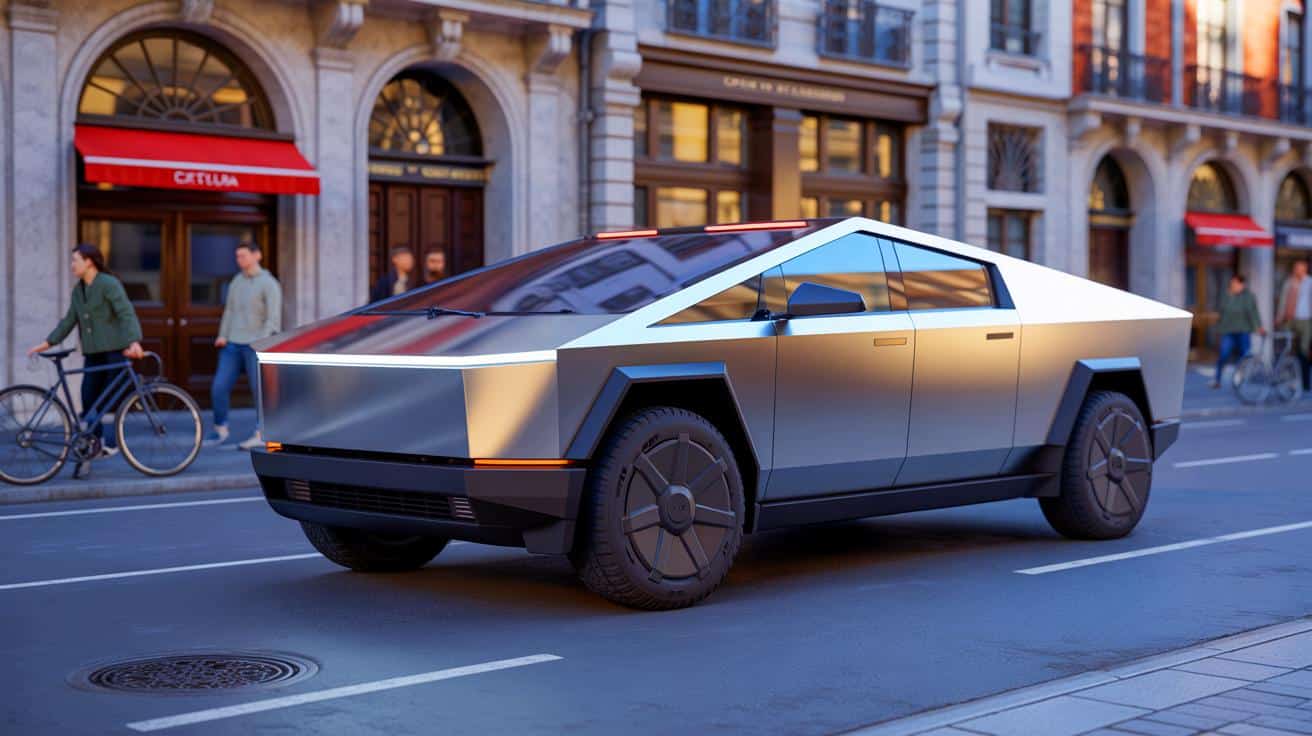
The crux of the issue lies in the Cybertruck’s design, which does not align with EU passive safety requirements. European regulators have strict rules that mandate impact protection zones, rounded edges, and designs that are crumple-friendly to minimize harm in collisions. These regulations are specifically crafted to protect pedestrians, cyclists, and motorcyclists. However, the Cybertruck’s sharp-edged, stainless-steel body deviates significantly from these norms. This aspect of the vehicle is not just a stylistic choice but a core feature that defines its futuristic appearance.
Another point of contention is the weight of the Cybertruck. EU regulations impose restrictions on heavier vehicles, requiring those over 3.5 metric tons to be fitted with speed limiters. The Cybertruck exceeds this weight threshold and does not have the necessary equipment to comply with this requirement. Without type-approval from the EU, the Cybertruck cannot be legally imported or operated by U.S. military personnel in Europe. This conundrum highlights a broader challenge for manufacturers: balancing innovative designs with regulatory demands.
German Authorities and the Denial of Exemption
In an attempt to navigate these regulatory hurdles, the U.S. Forces in Europe reached out to the German Federal Ministry of Transport to seek an exemption for their service members. The request was unequivocally denied. German authorities made it clear that the Cybertruck not only fails to meet EU legal requirements but also deviates significantly from them, rendering national individual vehicle approval impossible. This decision underscores the rigidity of European safety standards and the challenges faced by vehicles that push the boundaries of conventional design.
Moreover, the Cybertruck’s distinctive angular design poses additional challenges in terms of visibility. The U.S. Army Customs Agency expressed concerns that the vehicle’s unique appearance might attract undue attention on European roads. In a military context, this could undermine the purpose of U.S. military cover plates, which are intended to minimize the visibility of American personnel and equipment. Thus, the design of the Cybertruck, while revolutionary, may inadvertently conflict with operational security considerations for U.S. forces abroad.
A Broader Pattern of Restrictions
The Cybertruck is not the first American vehicle to face regulatory challenges in Europe. Historically, U.S.-made pickup trucks and SUVs have encountered obstacles due to differing weight and emissions standards. Even well-established models like the Ford F-150 have required modifications to meet European specifications. However, the Cybertruck stands out due to the extent of its non-compliance with European regulations. Its innovative design philosophy, spearheaded by Tesla, represents a bold departure from traditional automotive norms.
The Army Customs Agency has emphasized that the Cybertruck’s lack of compliance is widely known among regulatory bodies. Consequently, the vehicle remains off-limits for personal importation by military personnel in Europe. This ruling illustrates the ongoing tension between innovation in vehicle design and adherence to established safety standards. Despite the setback, Tesla's commitment to pushing the boundaries of automotive design continues to challenge regulatory frameworks worldwide.
The Future of the Cybertruck in Europe
The decision to prohibit the importation of the Cybertruck for U.S. military personnel stationed in Europe highlights a significant clash between Tesla’s avant-garde design and stringent EU regulations. While other vehicles can be shipped overseas by service members, compliance with host nation laws remains a mandatory aspect of the NATO agreements. This regulatory impasse raises questions about the future of the Cybertruck in the European market.
For now, Elon Musk’s angular electric truck remains a rarity on European roads, symbolizing the broader debate between innovation and safety. As automotive technology continues to evolve, manufacturers and regulators alike must grapple with how to integrate groundbreaking designs into existing frameworks. Will the automotive industry find a way to harmonize innovative design with global safety standards, or will such regulatory hurdles continue to pose significant challenges for pioneering vehicles like the Cybertruck?