
“Tesla’s Robot Car Just Crashed Hard”: Full Self-Driving Software Fails To See Metal Obstacle While Influencer’s Cross-Country Trip Ends In Disaster
 By
Ethan Kowalczyk
By
Ethan Kowalczyk
| IN A NUTSHELL |
|
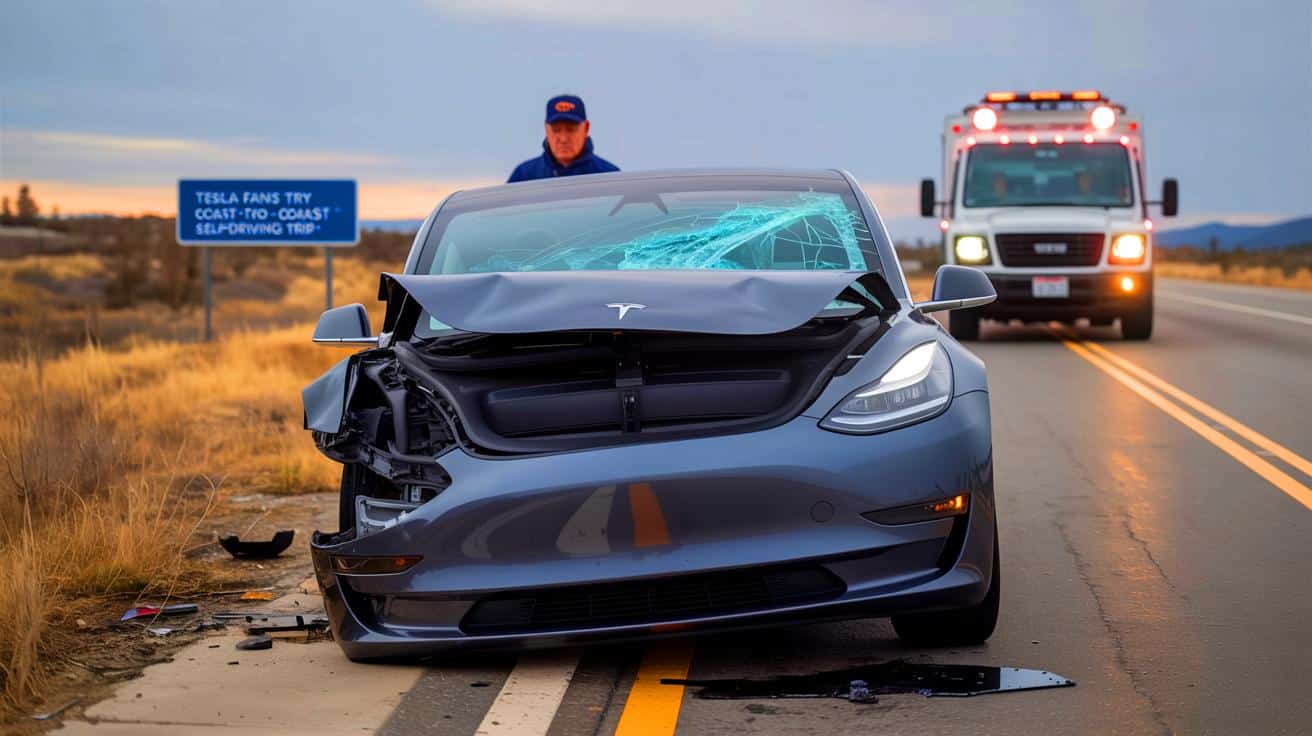
The allure of autonomous vehicles has captured the imagination of many, promising a future where cars drive themselves seamlessly across long distances. However, a recent incident involving two Tesla enthusiasts illustrates the current limitations and risks associated with this technology. Attempting a cross-country journey in a new Model Y equipped with Tesla’s much-touted “Full Self-Driving” (FSD) software, the trip was abruptly halted just 60 miles in. The car, failing to recognize a metal girder on the highway, crashed dramatically, highlighting ongoing concerns about the true capabilities of Tesla’s self-driving systems.
The Illusion of Autonomy
The concept of self-driving cars has been a topic of intense interest and development over the past decade. Tesla, under the leadership of CEO Elon Musk, has been at the forefront of this technological race. With his bold declarations and ambitious timelines, Musk has often projected a future where Tesla vehicles could navigate the entirety of the United States without human intervention. Despite these claims, the reality of Tesla’s Full Self-Driving software tells a different story.
While the name “Full Self-Driving” suggests a level of autonomy that many envision as the future of driving, the software still demands significant human oversight. The California Department of Motor Vehicles even took legal action against Tesla for what it considered misleading advertising. Officially renamed “Full Self-Driving (Supervised),” the naming remains contentious, as it implies a level of independence that the technology has yet to achieve.
A High-Profile Incident
The recent incident involving the "Bearded Tesla Guy," a social media influencer, serves as a stark reminder of the technology's current limitations. As the car barreled down the freeway, neither the driver nor the software recognized the looming threat in time. A metal girder, presumably fallen from a truck, was misjudged as roadkill by the passenger before it became clear that it was a significant obstacle.
The Model Y's failure to detect and avoid the object raised immediate concerns. The car's cameras, part of Musk's "vision only" approach, failed to trigger any evasive maneuvers or brake application. This oversight resulted in a hard crash, damaging the car's suspension and sway bar bracket. Fortunately, no one was injured, but the incident underscored the potential dangers of relying too heavily on current autonomous driving technologies.
Challenges in Sensor Technology
At the heart of Tesla's self-driving strategy is the decision to rely solely on camera-based vision systems. Musk has been vocal about his skepticism of lidar technology, dismissing it as a "crutch." This decision has sparked debate among experts and critics who argue that a multi-sensor approach, including radar and lidar, is essential for ensuring the safety and reliability of autonomous vehicles.
Cameras, while advanced, have limitations, especially in challenging lighting conditions. The recent crash exemplifies the potential pitfalls of a camera-only system that can be blinded by sunlight or obscured by weather conditions. A more robust sensor suite might have offered the Model Y additional data to better assess and react to the road obstacle.
The Road Ahead for Autonomous Vehicles
The pursuit of fully autonomous vehicles is a complex and challenging endeavor. While Tesla's advancements in self-driving technology are significant, incidents like the one involving the Model Y highlight the roadblocks that remain. The balance between safety and innovation is delicate, and as Tesla continues to refine its technology, the industry must grapple with both the potential and the pitfalls of autonomous driving.
Other automakers and tech companies are also exploring various approaches to self-driving technology, often opting for a more cautious, sensor-rich strategy. As the industry evolves, collaboration and transparency will be key in addressing safety concerns and building public trust in autonomous systems.
The recent Tesla incident serves as a reminder of the challenges and responsibilities associated with developing autonomous vehicles. As technology progresses, how will automakers address the critical safety concerns that continue to shadow the promise of self-driving cars?