
“They Called It a Bike-Car Hybrid”: Europe’s Frikar Is Redefining Urban Travel With a Weatherproof E-Bike You Can Drive Without a License
 By
Ethan Kowalczyk
By
Ethan Kowalczyk
| IN A NUTSHELL |
|
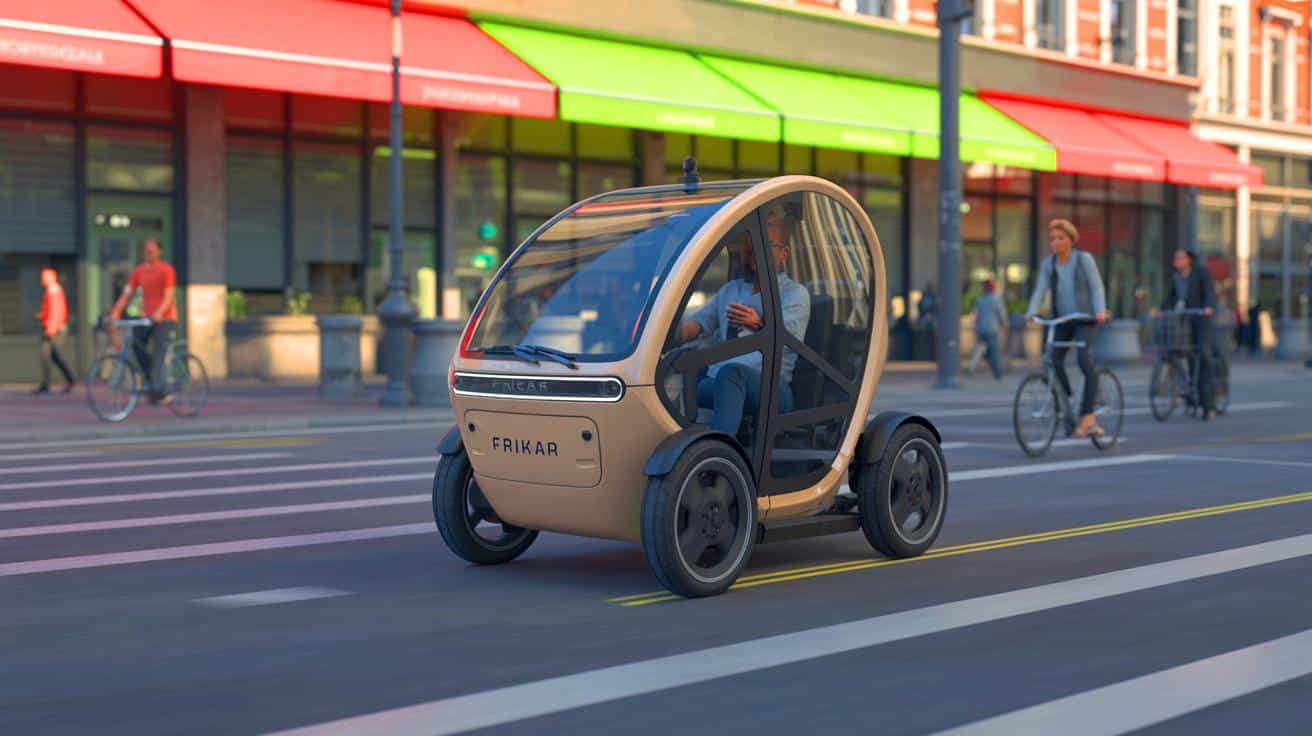
Across Europe, a new type of vehicle is quietly transforming the urban landscape. Known as the Frikar, this innovative machine combines elements of both bicycles and cars to create a unique form of transportation. Developed by the Norwegian startup Podbike, the Frikar offers an enclosed, pedal-assisted ride that can legally operate on roads without a license or registration. This development aligns with the growing trend in European cities to seek sustainable and space-efficient mobility solutions. As cities grapple with increasing populations and stringent climate goals, the Frikar presents a compelling alternative that challenges traditional transportation norms.
Reinventing the E-Bike With Four Wheels and a Windshield
The Frikar stands out with its distinctive design, which resembles a compact, aerodynamic capsule. Measuring less than 33 inches wide, it is narrow enough for bike lanes yet stable due to its four-wheel base. Weighing around 440 pounds, it is much lighter than the smallest electric cars. Despite its compact size, the Frikar is a marvel of engineering.
It is powered by two 250-watt hub motors located on the rear wheels, providing electric assistance to the rider’s pedaling. With a top speed of 15.5 mph, it complies with EU regulations for electric bicycles, allowing it to remain within the same legal category as standard e-bikes. This classification is crucial as it enables the Frikar to be driven without the need for a license or road registration, making it accessible to a wider audience.
The Frikar’s battery, rated at 877 kWh, offers a range between 31 and 50 miles, depending on the terrain and rider input. Charging is done through a standard plug but can also be partially recharged via regenerative energy from pedaling. Podbike is planning to introduce a dual-battery option in the future to extend the vehicle’s range even further.
Climate-Proof Commuting in a Shell Built for Cities
The Frikar’s most appealing feature is its enclosed cabin, made of polycarbonate, which protects riders from adverse weather conditions. This design is particularly advantageous in northern European cities, where cycling often decreases in colder months. The vehicle includes a curved windshield, integrated headlights, and optional child seating, enhancing its practicality in urban settings.
Inside, the Frikar offers a seating position more akin to a compact car than a bicycle. Steering is done with handlebars, and the drivetrain is controlled electronically with a shift-by-wire system. Additionally, the vehicle features brake assist that activates automatically if the vehicle exceeds its speed limit.
This innovative design is tailored to navigate the narrow lanes and limited parking spaces common in historical European city centers. As Andreas Haug, an early engineer of the project, eloquently put it, “It’s more than a new kind of bike, it’s a rethink of personal transport.”
Growing Demand in Germany and Beyond
The Frikar has generated significant interest since entering limited production, with over 3,000 pre-orders. Initial deliveries have begun in Germany and Norway, with further expansion planned in Switzerland, Belgium, and France throughout the year. Priced around $6,800 with a $300 deposit, it is positioned closer to a high-end e-bike than a low-end car, yet this has not deterred potential buyers.
Experts in transportation see this as a timely development. Dr. Eva Müller, a mobility researcher, notes, “Urban transport policy is undergoing radical change. Vehicles like Frikar may be niche today, but they reflect a deeper trend toward decentralized, multimodal travel.” The European Union’s climate initiatives, such as the Fit for 55 package, support micromobility innovations, potentially accelerating the adoption of the Frikar in densely populated areas.
Podbike has integrated modern technology into the Frikar, providing a dedicated smartphone app for over-the-air updates, diagnostics, and system checks. While it may not match the power or speed of traditional cars, it offers a unique journey prioritizing convenience, climate resilience, and compactness.
Why trucks remain essential for small businesses in the modern era
What’s Next for Frikar?
The Frikar addresses a critical need for reducing car traffic and emissions in urban areas by providing a middle ground solution that bypasses some contentious mobility issues. It is legal where electric scooters are not, offers more safety than bicycles in inclement weather, and is more compact than any electric vehicle currently available.
However, challenges persist. The vehicle’s safety in mixed traffic conditions, maintenance standards, and real-world battery performance are yet to be fully evaluated. Despite these hurdles, the growing interest and initial success suggest that the Frikar could soon become a common sight on city streets across Europe.
The Frikar’s emergence prompts a broader question: How will cities continue to innovate and adapt to meet the demands of sustainable urban mobility in the face of growing environmental concerns?