



“Tiny Laser Fits On Penny Saves Self-Driving Cars”: University Creates Chip That Measures Distance Instantly While Bulky Sensors Become Obsolete Forever
 By
Keisha Holloway
By
Keisha Holloway
| IN A NUTSHELL |
|
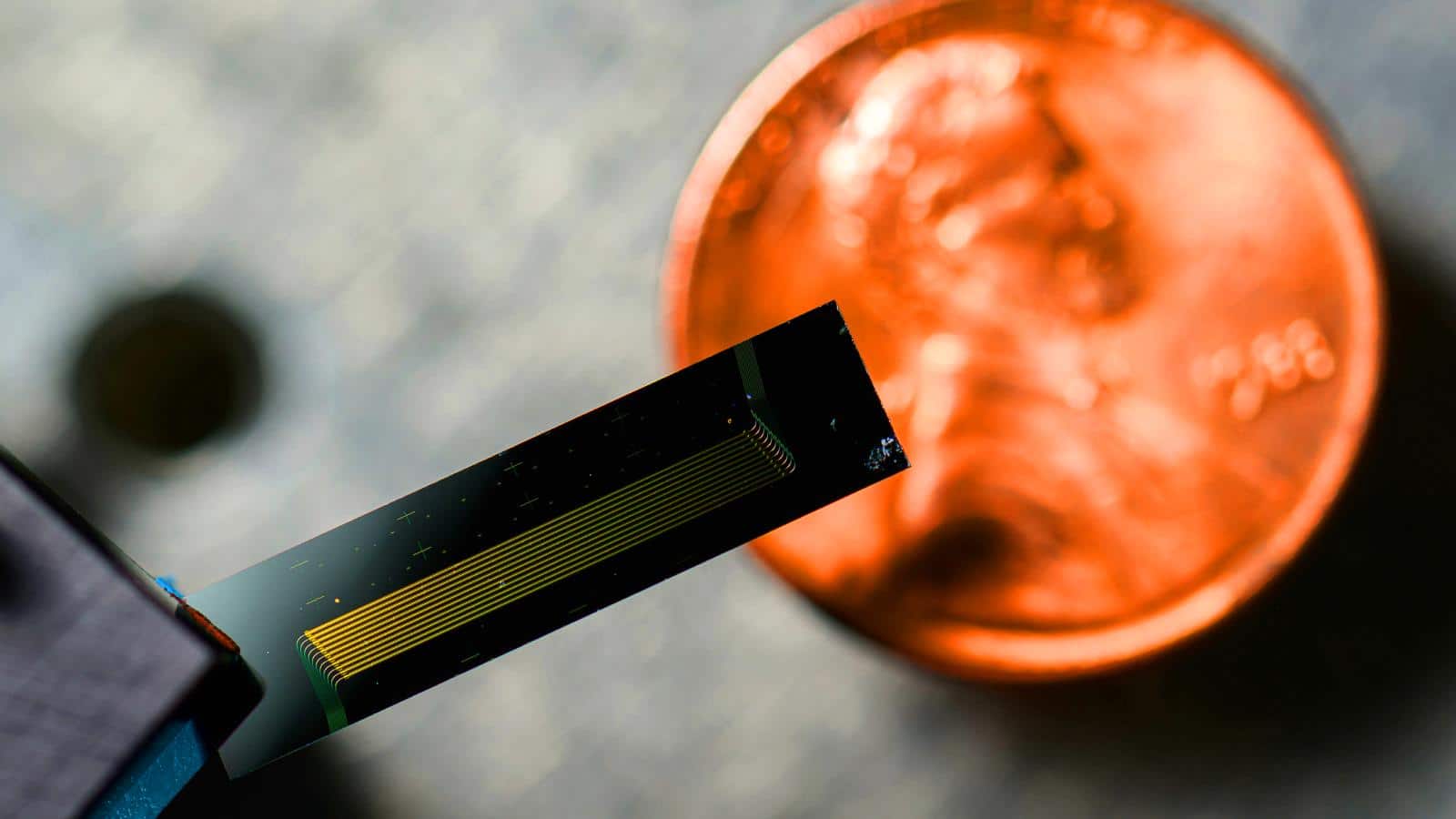
In the rapidly evolving landscape of autonomous vehicle technology, a breakthrough from the University of Rochester offers a promising new tool. Researchers have developed a chip-scale laser, small enough to fit on a penny, which could revolutionize the way driverless cars perceive their surroundings. By harnessing advanced optical metrology techniques, this laser promises to enhance the speed and accuracy of light detection and ranging systems, commonly referred to as lidar. This innovation could pave the way for safer, more reliable autonomous navigation, addressing some of the key challenges current systems face.
The Role of Lidar in Autonomous Navigation
Lidar technology has become a cornerstone in the development of autonomous vehicles. It works by emitting laser pulses and measuring the time it takes for these pulses to bounce back from objects. This process creates a detailed map of the vehicle’s surroundings, providing crucial data on the size, distance, and velocity of nearby objects. However, existing lidar systems can be complex and prone to errors, limiting their effectiveness in real-world applications.
The new laser developed by the University of Rochester team seeks to address these limitations. It operates by rapidly changing its color across a broad spectrum of light, a capability that enhances the precision of measurements. This advancement is particularly significant for a form of lidar known as frequency-modulated continuous-wave (FMCW) lidar, which requires lasers with a large tuning range and fast frequency tuning capabilities.
Shixin Xue, the lead author of the study, highlights that the new laser can perform these tasks with greater speed and accuracy than its predecessors. This capability not only improves the reliability of autonomous vehicle systems but also has the potential to reduce the complexity and size of lidar sensors, making them more practical for widespread use.
Applications Beyond Autonomous Vehicles
While the primary focus of this innovation is on improving autonomous vehicle navigation, the potential applications extend far beyond. The laser's ability to track fast-moving objects with high precision makes it a valuable tool in various sectors. For instance, it could enhance systems used in quantum information processing, where the accuracy of laser measurements is critical.
Additionally, the laser's compact size and efficiency could benefit the aerospace industry. Current autonomous systems require large sensors that impact the aerodynamics of vehicles. By integrating this new laser technology, aircraft could achieve lower air drag, improving fuel efficiency and performance.
The technology could also play a role in scientific research, such as the detection of gravitational waves. The precision and reliability of the laser make it suitable for experiments requiring highly accurate measurements, expanding the possibilities for scientific discovery.
Technical Innovation: Miniaturizing Complex Systems
A significant achievement of the University of Rochester team is the miniaturization of equipment typically required for laser frequency locking, a process crucial for stabilizing laser noise. Traditionally, this process involved bulky equipment comparable in size to a desktop computer. However, the new chip-scale laser integrates all necessary components into a compact device.
This shrinkage is achieved through the integration of elements such as an intrinsic laser, an isolator, and modulating devices into a single chip. This innovation not only reduces the space required for these systems but also simplifies their operation, making them more accessible for various applications.
Such advancements underscore the potential for this laser to transform industries reliant on precise optical measurements. By reducing the size and complexity of necessary equipment, the technology can be deployed in more locations and used in a wider range of applications, from industrial settings to scientific research facilities.
Future Prospects and Challenges
The development of this chip-scale laser represents a significant step forward in optical technology, yet challenges remain before it can be widely implemented. Integrating this technology into existing systems will require collaboration between researchers, manufacturers, and industry stakeholders. Scaling up production while maintaining the laser's precision and efficiency is another hurdle that must be addressed.
The research received support from the U.S. Defense Advanced Research Projects Agency (DARPA), indicating its potential military applications. Such support could accelerate the development and deployment of this technology, providing a pathway for its adoption in both military and civilian sectors.
As advancements continue, the impact of this technology on the autonomous vehicle industry and beyond will depend on overcoming these challenges. The promise of safer, more efficient systems is within reach, but realizing this potential will require sustained effort and innovation.
The advent of this new laser technology raises crucial questions about the future of autonomous systems and their role in society. How will this innovation shape the development of driverless vehicles, and what other industries might be transformed by these advancements? As the technology matures, the answers to these questions will become increasingly significant.
Continue reading